Oven-safe mixing bowls let you go from freezer to oven without swapping containers, saving time and reducing dishes.
Borosilicate glass and thick tempered glass stand up to rapid temperature changes and resist cracking.
Look for snug lids, sturdy rims, and a range of sizes for prep, storage, and baking.
Below are the best options that balance durability, heat performance, and everyday practicality.
| SIMAX 2.6 Qt Borosilicate Glass Mixing Bowl |  | Classic Everyday | Material: Borosilicate glass | Oven-safe: Oven-safe | Microwave-safe: Microwave-safe | VIEW LATEST PRICE | Read Our Analysis |
| KOMUEE 4-Piece Oven-Safe Glass Mixing Bowls Set | Best for Families | Material: Borosilicate glass | Oven-safe: Oven-safe | Microwave-safe: Microwave-safe | VIEW LATEST PRICE | Read Our Analysis | |
| Luvan Glass Mixing Bowls with Lids (3-Pack) | Airtight Storage Winner | Material: Borosilicate glass | Oven-safe: Oven-safe (preheated oven OK) | Microwave-safe: Microwave-safe | VIEW LATEST PRICE | Read Our Analysis | |
| SIMAX 3.6 Qt Borosilicate Glass Mixing Bowl | 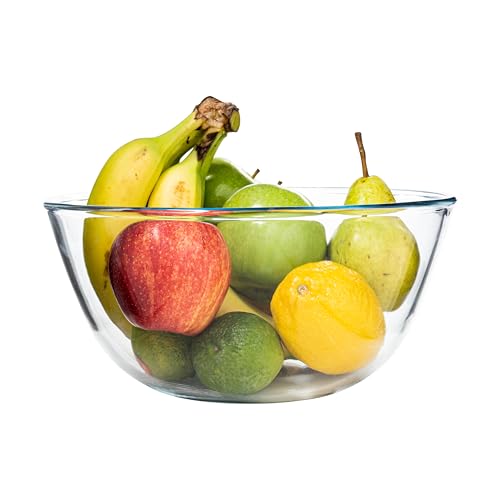 | Large-Capacity Favorite | Material: Borosilicate glass | Oven-safe: Oven-safe | Microwave-safe: Microwave-safe | VIEW LATEST PRICE | Read Our Analysis |
| 3-Piece Borosilicate Glass Mixing Bowl Set (Microwave Safe) | Durable Multi-Pack | Material: Borosilicate glass | Oven-safe: Oven-safe | Microwave-safe: Microwave-safe | VIEW LATEST PRICE | Read Our Analysis |
More Details on Our Top Picks
SIMAX 2.6 Qt Borosilicate Glass Mixing Bowl
Should you want a versatile, no-nonsense bowl that moves from fridge to oven without drama, the SIMAX 2.6 Qt borosilicate glass mixing bowl is an ideal choice—its thermal-shock–resistant glass lets you mix batter, chill dough, reheat leftovers, or bake casseroles using the same simply graceful vessel. You’ll appreciate clear, pure glass that won’t absorb odors or flavors, and a tight-fitting lid for storage. At 2.6 quarts and 9 x 5 inches, it’s roomy yet manageable. Oven-, microwave-, and dishwasher-safe, cadmium- and lead-free, and made in the Czech Republic, it’s reliable for everyday prep and serving.
- Material:Borosilicate glass
- Oven-safe:Oven-safe
- Microwave-safe:Microwave-safe
- Dishwasher-safe:Dishwasher-safe
- Freezer-safe / Refrigerator-safe:Fridge/freezer transitions noted (thermal-shock resistant)
- Lead/cadmium-free / Food-safe:100% cadmium- and lead-free; food-safe
- Additional Feature:Includes tight-fitting lid
- Additional Feature:Made in Czech Republic
- Additional Feature:Thermal-shock resistant
KOMUEE 4-Piece Oven-Safe Glass Mixing Bowls Set
Should you bake, meal-prep, or store leftovers regularly and want one set that handles mixing, oven-to-table baking, and fridge-to-microwave reheating, the KOMUEE 4-piece borosilicate glass bowls are an ideal pick—each bowl is oven-, microwave-, freezer-, and dishwasher-safe and nests for compact storage. You get four clear bowls (0.8, 1.7, 2.9, 4.8 QT) with matching plastic lids that’re BPA-free. The glass resists thermal shock, so you can move from oven to fridge without worry. They’re stylish enough for serving, durable for everyday use, and weigh about nine pounds for the whole set. Manufacturer warranty info is available.
- Material:Borosilicate glass
- Oven-safe:Oven-safe
- Microwave-safe:Microwave-safe
- Dishwasher-safe:Dishwasher-safe
- Freezer-safe / Refrigerator-safe:Freezer-safe / refrigerator-safe
- Lead/cadmium-free / Food-safe:BPA-free lids; glass food-safe (BPA free noted)
- Additional Feature:Nesting space-saving design
- Additional Feature:Four-piece graduated sizes
- Additional Feature:Matching plastic storage lids
Luvan Glass Mixing Bowls with Lids (3-Pack)
Should you want durable, oven-safe mixing bowls that double as airtight storage, the Luvan 3-pack is a smart pick — made from thick borosilicate glass with ribbed exteriors and BPA-free polypropylene lids, they withstand -4°F to 1040°F for baking, reheating, chilling, and freezing while nesting neatly to save space. You’ll get 3.7 qt, 2.1 qt, and 1.1 qt bowls with smooth interiors and thickened edges for grip. Use them in oven, microwave, fridge, freezer, and dishwasher (bowls only); lids seal food but aren’t dishwasher-safe. They’re easy to clean, versatile for prep or storage, and make a practical gift. Support responds to defects within 24 hours.
- Material:Borosilicate glass
- Oven-safe:Oven-safe (preheated oven OK)
- Microwave-safe:Microwave-safe
- Dishwasher-safe:Dishwasher-safe (bowls only; lids not dishwasher-safe)
- Freezer-safe / Refrigerator-safe:Freezer and fridge safe (cold-to-heat tolerant)
- Lead/cadmium-free / Food-safe:Lead-free, food-grade materials; BPA-free lids
- Additional Feature:Ribbed exterior grip
- Additional Feature:Airtight PP lids
- Additional Feature:Wide temperature range
SIMAX 3.6 Qt Borosilicate Glass Mixing Bowl
Should you want a durable, multiuse bowl that goes from oven to fridge without worry, the SIMAX 3.6 qt borosilicate glass mixing bowl is a smart pick—its high thermal shock resistance and oven- and microwave-safe construction make it ideal for bakers who prep, bake, and serve in the same dish. You’ll mix batter, dough, salads, eggs, and sauces, then use it as a double boiler or serving vessel. The borosilicate glass won’t absorb odors or flavors and is cadmium- and lead-free, made in the Czech Republic. It’s dishwasher-safe, clear for easy monitoring, and holds 3.6 quarts.
- Material:Borosilicate glass
- Oven-safe:Oven-safe
- Microwave-safe:Microwave-safe
- Dishwasher-safe:Dishwasher-safe
- Freezer-safe / Refrigerator-safe:Fridge-to-oven transitions noted (thermal-shock resistant)
- Lead/cadmium-free / Food-safe:100% cadmium- and lead-free; food-safe
- Additional Feature:Large 3.6-quart capacity
- Additional Feature:Prep-and-serve design
- Additional Feature:Made in Czech Republic
3-Piece Borosilicate Glass Mixing Bowl Set (Microwave Safe)
In case you want durable, heatproof bowls that go straight from freezer to oven or microwave, this 3-piece borosilicate glass set is a smart choice—its 0.3-inch-thick walls tolerate -40°F to 572°F and resist cracking, so you can mix, chill, reheat, and bake with confidence. You get 1 qt, 2.5 qt, and 4.2 qt sizes: use the small for dips, the medium for fruit salad or sides, and the large for mixing. The deeper design with higher sides prevents spills. Glass looks better than plastic, nests for compact storage, cleans easily, and is oven, microwave, sterilizer, fridge, and freezer safe. Contact support for help; they respond within 12 hours.
- Material:Borosilicate glass
- Oven-safe:Oven-safe
- Microwave-safe:Microwave-safe
- Dishwasher-safe:Dishwasher-safe
- Freezer-safe / Refrigerator-safe:Fridge and freezer safe
- Lead/cadmium-free / Food-safe:High borosilicate glass, implied food-safe (no harmful chemicals noted)
- Additional Feature:Extra-thick 0.3″ walls
- Additional Feature:Deeper high-sided design
- Additional Feature:Nested compact storage
Factors to Consider When Choosing Oven Safe Mixing Bowls
Once I pick oven-safe mixing bowls, I check the material and durability initially — glass, stainless steel, and ceramic all behave differently under heat. I also consider thermal shock resistance, size and capacity, and whether lids fit tightly for storage and oven use. Finally, I verify oven and appliance safety ratings so I know each bowl can handle the temperatures and equipment I plan to use.
Material And Durability
Although different materials can handle heat and wear in distinct ways, I focus initially on what the bowl is made of and how that affects longevity and safety. I favor borosilicate glass because it’s nonporous, resists staining and odors, and—within specified temperature ratings—handles oven, microwave, fridge, and freezer use. Thicker walls (around 0.3 inch) and reinforced rims matter: they cut chipping and extend life under repeated heating and handling. Always check the manufacturer’s temperature tolerance (commonly from about -40°F to roughly 500°F/260°C) so you don’t exceed limits. For storage, choose lids that are BPA‑free and verify bowls are certified lead‑ and cadmium‑free; lid materials can undermine otherwise durable, safe cookware.
Thermal Shock Resistance
Having settled on borosilicate for its durability and nonporous surface, I now look at how bowls handle rapid temperature swings — their thermal shock resistance. This property is a material’s ability to survive quick temperature changes without cracking, usually expressed as a maximum temperature differential. Borosilicate outperforms soda-lime, often tolerating several hundred degrees between oven, microwave, fridge, and freezer. Whenever I shop, I check product specs for rated temperature ranges or explicit shift claims—those numbers matter. I prefer thicker, uniformly shaped bowls with consistent wall thickness and no abrupt geometry changes, since they reduce stress concentration. Finally, I avoid direct flame, sudden contact with very hot plates, or setting hot glass on cold wet surfaces, all common triggers for thermal shock failure.
Size And Capacity
Consider what you actually cook and pick bowl sizes to match: I use 1–2 qt bowls for whisking eggs or dressings, 2.5–4 qt for batters and salads, and 4–6+ qt for big batches, doughs, or family meals. I recommend a nesting set with graduated sizes (roughly 1–4+ qt) for versatility and compact storage. Consider beyond volume: deeper bowls cut splatter when whisking, while wider bowls make folding and tossing easier. Match capacity to household needs—single cooks often do fine with 1–3 qt pieces; families and frequent bakers want 3.6–6 qt or larger. When planning for storage or multi-stage prep, allow about 20–30% extra headspace so mixtures can expand or leftovers fit comfortably.
Lid Compatibility And Seal
Once you’ve picked bowl sizes that fit your cooking and storage needs, consider lids—how well they fit and what they’ll tolerate matters almost as much. I always check that lids are heat-resistant, BPA-free, and rated to the same temperature range as the bowl in case I plan to use them in microwave, freezer, or dishwasher. I verify whether a lid is truly airtight or merely splash-resistant—airtight keeps refrigerated food fresher and prevents freezer burn, while splash-resistant works for reheating. I prefer lids designed for nesting and stacking (flat or locking styles) to save space and avoid warping in the dishwasher. Before any high-heat use, I confirm manufacturer temperature limits, and I favor lids with vents or removable plugs to release microwave pressure.
Oven And Appliance Safety
Although oven-safe often sounds straightforward, I always dig into material and temperature specs before I bake or roast with a mixing bowl. I check material initial: borosilicate glass, tempered glass, or certain ceramics handle high heat and thermal shock far better than regular glass or plastic. I verify the maximum safe temperature—many borosilicate pieces withstand several hundred°F—and match that to the recipe. I confirm compatibility with other appliances too, since oven-safe doesn’t automatically mean microwave- or freezer-safe; those ratings should be listed separately. I look for explicit thermal-shock resistance or statements allowing fridge-to-oven shifts, because sudden temperature changes can still crack things. Finally, I inspect lids and accessories: most plastic lids aren’t oven-safe and must be removed or replaced with oven-safe covers.
Cleaning And Maintenance
Because I use oven-safe mixing bowls across temperature extremes, I pay close attention to cleaning and maintenance so they last and stay safe. I verify material-specific care: borosilicate and tempered glass usually tolerate dishwasher, microwave, oven, and freezer use, but lids, plastic, or silicone seals often need hand-washing and can’t take high heat. I always follow manufacturer temperature limits and thermal-shock guidance—extreme hot-to-cold shifts invite cracking. I remove non-glass parts and wash them separately per care labels to protect gaskets and prevent warping. For daily cleaning I use mild detergent and non-abrasive sponges to avoid scratches that weaken glass. I store nested bowls with soft liners or alternating orientation to prevent rim-to-rim contact and limit chips.