
You’ll find top glass electric cooktops that blend sleek vitro-ceramic tops with powerful radiant zones and smart controls for precise, reliable cooking. Whether you want compact 23–36″ models, expandable dual elements, or up to 9000W for simultaneous high heat, there’s a design that fits your kitchen and cooking habits. I’ll highlight the best options, key features, and what to watch for so you can pick the right one.
| 30″ Electric Ceramic Cooktop 4-Burner Touch Control |  | Family Favorite | Burner Count: 4 burners | Surface Type: Ceramic glass (satin black) | Control Type: Touch sensor control | VIEW LATEST PRICE | Read Our Analysis |
| Happybuy 23.2″ 4-Burner Glass Radiant Electric Cooktop | Compact Choice | Burner Count: 4 burners | Surface Type: Glass radiant cooktop | Control Type: Digital sensor touch controls | VIEW LATEST PRICE | Read Our Analysis | |
| 30″ 5-Burner Electric Glass Ceramic Cooktop |  | High-Capacity Performer | Burner Count: 5 burners | Surface Type: Glass ceramic | Control Type: Slide touch sensor control | VIEW LATEST PRICE | Read Our Analysis |
| 36″ 5-Burner Matte Glass Electric Cooktop (9000W) |  | Powerhouse Premium | Burner Count: 5 burners | Surface Type: Matte ceramic glass | Control Type: Touch control | VIEW LATEST PRICE | Read Our Analysis |
| Karinear 30″ 4-Burner Electric Ceramic Cooktop | 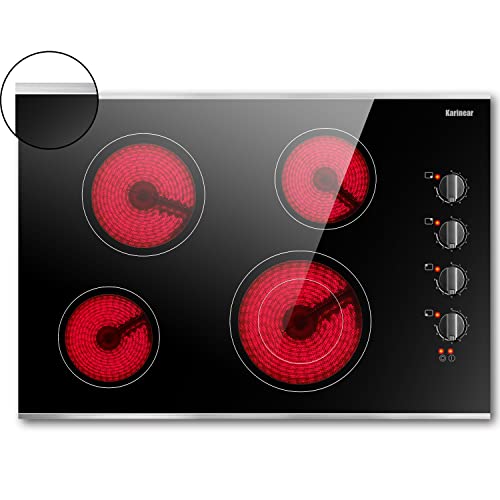 | Easy-Use Classic | Burner Count: 4 burners | Surface Type: Tempered glass (radiant ceramic) | Control Type: Rotary knob controls | VIEW LATEST PRICE | Read Our Analysis |
More Details on Our Top Picks
30″ Electric Ceramic Cooktop 4-Burner Touch Control
In case you cook for a family or often prepare multiple dishes at once, the 30″ Electric Ceramic Cooktop with 4 touch-controlled burners and 6,700W total power gives you the space and rapid, precise heat control you need. You’ll use nine power levels, independent timers (1–99 minutes) and touch sensors for intuitive adjustments. The satin black radiant surface cleans with a damp cloth; stubborn melted sugar or plastic should be scraped while hot to prevent marks. Safety features include child lock, overheat protection, auto shut-off and residual-heat indicators. It accepts stainless steel, enamel, cast iron, ceramic and copper cookware.
- Burner Count:4 burners
- Surface Type:Ceramic glass (satin black)
- Control Type:Touch sensor control
- Safety Features:Child lock, overheat protection, residual-heat indicator, auto switch-off
- Timer Function:1–99 minutes (independent per burner)
- Voltage / Power Supply:220–240 V, 50/60 Hz, total 6700 W
- Additional Feature:Satin black glass surface
- Additional Feature:9 power levels per burner
- Additional Feature:Residual-heat indicator
Happybuy 23.2″ 4-Burner Glass Radiant Electric Cooktop
Should you’re after a compact, high-power built-in cooktop that handles four pans at once, the Happybuy 23.2″ 4-burner glass radiant model fits the bill—its 6000W total output and nine power levels let you simmer, sear, and boil with precise control while the heat-resistant glass surface keeps cleanup quick. You’ll get four independent zones with touch sensor controls, a 0–99 minute timer, and independent zone control so you can multitask. Safety features include child lock, overheat protection, automatic shutoff for spills, and residual heat indicators. It fits a 22 x 19.3 inch cutout, weighs 18.7 lbs, and supports 220–240V.
- Burner Count:4 burners
- Surface Type:Glass radiant cooktop
- Control Type:Digital sensor touch controls
- Safety Features:Child lock, overheat protection, automatic shutoff for spills, residual-heat indicator
- Timer Function:0–99 minutes (independent zone control)
- Voltage / Power Supply:220–240 V, 60 Hz, total 6000 W
- Additional Feature:Compact 23.2″ footprint
- Additional Feature:Fits 22 x 19.3″ cutout
- Additional Feature:8.5 kg net weight
30″ 5-Burner Electric Glass Ceramic Cooktop
In case you cook for a family or entertain often, this 30″ 5-burner glass ceramic cooktop gives you the flexible power distribution and dual-zone burner control to handle multiple pots and pan sizes with ease. You get a 30″ IsEasy LI5-01 built-in unit with five zones ranging from 1.2 kW to a 2.4 kW dual element, nine heat levels, and an 8,200 W total. Slide-touch controls include timer and pause. Safety features—child lock, automatic shut-off, overheat and residual-heat indicators—keep cooking secure. The scratch-resistant vitro-ceramic surface cleans easily and fits flat-based cookware.
- Burner Count:5 burners
- Surface Type:Glass ceramic
- Control Type:Slide touch sensor control
- Safety Features:Child lock, automatic shut-off, overheat protection, residual-heat indicator
- Timer Function:Timer and pause functions (per burner/zone)
- Voltage / Power Supply:220–240 V, total 8200 W
- Additional Feature:Dual-zone burner element
- Additional Feature:Slide touch sensor control
- Additional Feature:8200W total wattage
36″ 5-Burner Matte Glass Electric Cooktop (9000W)
Home cooks who want precise low-heat control and a sleek, durable surface will appreciate this 36″ 5-burner matte glass electric cooktop, which pairs a dedicated low-power melting zone and two expandable burners with a scratch- and fingerprint-resistant Italian ceramic glass top. You get 9000W total across five radiant zones (500W, 1200W, 1800W, 2500W, 3000W), nine heat levels, and a continuous 500W low setting for melting or sous-vide-style tasks. Touch controls, a 99-minute timer, child lock, overheat protection and auto shut-off keep cooking safe. It’s built-in, hard-wired 240V—professional installation required.
- Burner Count:5 burners
- Surface Type:Matte ceramic glass
- Control Type:Touch control
- Safety Features:Overheat protection, auto shut-off, child safety lock, residual-heat indicator
- Timer Function:Up to 99 minutes
- Voltage / Power Supply:220–240 V (240 V listed), hard-wired, total 9000 W
- Additional Feature:Anti-fingerprint matte glass
- Additional Feature:Included scraper tool
- Additional Feature:Hard-wired installation
Karinear 30″ 4-Burner Electric Ceramic Cooktop
Should you want a straightforward, tactile cooktop that’s easy to operate and durable, the Karinear 30″ 4-burner ceramic model fits the bill—its tempered glass surface with a protective metal frame resists impact and cleans up with a quick wipe, while four varied burners (including a dual 1250/2500 W zone) give you flexible heat for everything from simmering to deep-frying. You’ll get simple rotary knobs with nine power levels per zone, hot-surface indicators, and over-temperature shutoff. It drops into standard cabinets, runs on 220–240 V hard-wired supply, uses radiant ceramic heating, and works with any cookware material for efficient cooking.
- Burner Count:4 burners
- Surface Type:Tempered glass (radiant ceramic)
- Control Type:Rotary knob controls
- Safety Features:Hot surface indicator, over-temperature protection, automatic shutoff
- Timer Function:9 power levels (timer implied via controls) — (hot-surface indicator and auto shutoff noted; explicit 0–99 min timer not specified)
- Voltage / Power Supply:220–240 V, hard-wired, burner watts listed (total ~?); burners 1200/1200/1800/1250+2500 W (radiant)
- Additional Feature:Metal protection frame
- Additional Feature:Rotary knob controls
- Additional Feature:Dual 1250/2500W burner
Factors to Consider When Choosing Glass Electric Cooktops
When choosing a glass electric cooktop, you’ll want to compare power and burner layout to match how you cook and the pots you use. Consider control type options, safety features, and surface durability so you get precise heating and long-lasting performance. Also check heating performance levels to make certain the cooktop can handle everything from gentle simmering to rapid boiling.
Power And Burner Layout
Consider through total wattage and burner layout together, because they determine how many pots you can run at once and how well different pan sizes will cook. You’ll want a cooktop in the 6–9 kW range should you plan to use multiple burners at high heat without throttling. Check that the layout offers 3–5 zones with a mix of small, medium, and at least one high-power or dual/expandable zone so large pans fit and heat evenly. Review individual burner wattages and available heat levels to match tasks—low-wattage zones for simmering or melting, high-wattage for boiling or searing. Confirm minimum continuous low-power capability (around 500 W) for delicate work and look for dual zones that combine for broader, more uniform heating.
Control Type Options
Although controls are often an afterthought, the type you choose directly affects usability, safety, and how precisely you can cook. Touch controls give a sleek, easy-to-clean surface with digital timers and multiple heat levels (often nine), but they struggle with wet or gloved hands and can trigger accidentally. Rotary knobs deliver tactile feedback, quick adjustments, and simple repairs or replacements; they work well should your hands be wet or you wear gloves. Slide or touch-slider controls let you make fine, continuous changes for simmering or melting. Physical controls suit users with limited vision or dexterity, while touch sensors might include child-lock and pause features. Check responsiveness and feedback—audible beeps, visual displays, or haptic cues—so you get clear confirmation of settings.
Safety And Protection
Because glass cooktops run hot and sit flush with your countertop, you’ll want built-in safeguards that prevent burns, fires, and accidental activation. Look for residual-heat indicators so you and others can see which zones remain hot after use. Choose models with automatic shut-off and overheat protection to cut power should a zone exceeds safe temperatures or is left on too long. Make sure a child safety lock or control-panel lock is available to block accidental activation unless kids or during cleaning. Prefer designs that minimize heat transfer to surrounding countertop edges and include clear hot-surface warnings to reduce burn risk. Finally, verify spill detection or automatic shutoff for large spills to prevent electrical faults and fire hazards.
Surface Material Durability
Whenever you’re comparing glass-ceramic cooktops, focus on the surface material and finish since they determine scratch resistance, thermal shock tolerance, and how much upkeep you’ll need. Choose vitro-ceramic or tempered glass for high-temperature and thermal-shock resistance; they let radiant elements sit directly beneath without cracking. Check surface hardness ratings: higher-quality ceramic glass resists routine cookware but can still be scored by dragged pots, metal utensils, or abrasive cleaners. Look for heat-resistant coatings and matte or satin finishes to hide fingerprints and stains; glossy tops show smears and need more frequent cleaning. Toughened edges and metal frames enhance impact resistance and cut chipping risk during installation or knocks. Preserve the surface with non-abrasive cleaners, steer clear of sudden temperature shifts, and remove melted sugar or plastic promptly.
Heating Performance Levels
Pay attention to heating performance: total wattage and individual zone outputs determine how quickly burners boil and how well you can run several pots at once, so higher aggregate power means faster heating and steadier performance under load. You’ll want clear variable power settings—commonly nine levels—so you can move reliably from low simmer to high boil. Check for dual‑ or expandable‑zone elements that let you match heat area to pan size and redistribute power for large cookware. Look for continuous low‑power capability (around 500 W) for gentle melting or warming without cycling. Finally, consider ceramic glass heat retention and residual‑heat indicators: faster‑responding elements plus visible indicators give you better control and safer, more accurate cooking.
Cookware Compatibility
Compatibility matters: matching your cookware to a glass electric cooktop guarantees efficient heat transfer, even cooking, and safer use. Choose flat-bottom pots and pans—stainless steel, cast iron, enamel, copper, or aluminum—to guarantee full contact with the glass-ceramic surface. Avoid warped or rounded bottoms, which create poor contact, slow heating, and hot spots. Consider material and thickness: thin aluminum responds quickly but cools fast; thick stainless or cast iron holds and evens heat. You don’t need magnetic cookware (that’s for induction), but very thin glass or some ceramics won’t conduct well and perform poorly. Finally, match pot diameter to the burner: tiny pots waste energy, while oversized ones can heat unevenly unless the element offers expandable or dual-zone coverage.
Installation And Wiring
Because glass electric cooktops draw substantial power and sit flush with your countertop, you should confirm electrical, dimensional, and structural requirements before buying. Verify your kitchen supply meets the cooktop’s 220–240 V and amperage needs—most models draw several kilowatts—so validate circuit capacity and breaker rating. Decide between plug‑in and hard‑wired units; plug models need an appropriately rated outlet and cord, while hard‑wired or high‑wattage cooktops usually require a dedicated circuit, proper cable gauge, and a licensed electrician for installation and fused disconnects. Check the manufacturer’s cutout dimensions, depth, and minimum clearances for ventilation beneath the unit. Finally, make certain your countertop material, support, and nearby cabinetry meet weight, heat exposure, and local code clearance requirements.
Cleaning And Maintenance
At the moment you choose a glass electric cooktop, consider how easy it will be to keep the glass-ceramic surface clean and damage-free: wipe it after each use with a damp cloth and mild detergent to prevent grease buildup, scrape melted sugar or plastic with a plastic or specialty scraper while the surface is warm (never hot), and avoid abrasive pads or powdered cleaners that can scratch the finish. Wipe acidic spills (vinegar, tomato, citrus) promptly to prevent etching and dulling, then dry to reduce streaks and water spots. Use non-abrasive cleaners made for vitro-ceramic tops for tougher residues. Periodically clean control areas, seals, and underside edges whenever cool to stop buildup that can impair touch sensors, knobs, or heat transfer.
