
Assuming you want a santoku that resists rust and keeps a keen edge, you’ll want materials and construction that work together. Consider high-corrosion steels, protective coatings, and sealed or stabilized handles so moisture can’t creep in. I’ll walk you through top picks—from coated budget sets to artisan Japanese blades—and the key features to check before you buy, so you get a knife that stays reliable in real kitchens.
| Granitestone Nutriblade 12-Piece Santoku Knife Set | 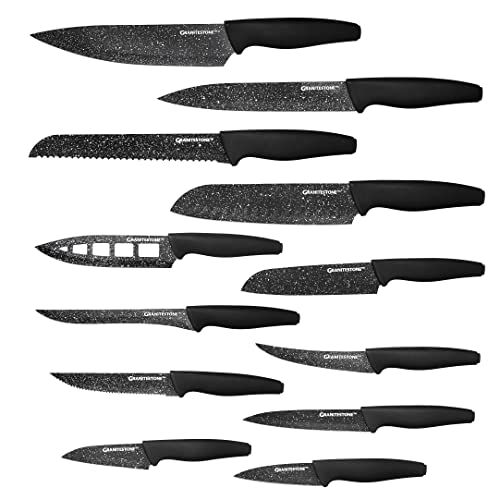 | Best for Families | Blade Material / Construction: High-grade stainless steel blades, coated (forged/constructed for durability) | Rust / Corrosion Resistance: Mineral-based, diamond-infused Granitestone nonstick coating resists rust/stains | Blade Length (Santoku model): Multiple santoku sizes in set (7″, 5″, 4″) | VIEW LATEST PRICE | Read Our Analysis |
| YARENH 7″ Santoku 67-Layer Damascus Chef Knife |  | Premium Craftsmanship | Blade Material / Construction: 67-layer high-carbon Damascus (10Cr15MoV core, forged) | Rust / Corrosion Resistance: 10Cr15MoV core with superior corrosion/rust resistance | Blade Length (Santoku model): 7″ Santoku blade | VIEW LATEST PRICE | Read Our Analysis |
| MASAMOTO MV 7″ Santoku Knife Made in Japan |  | Traditional Japanese Classic | Blade Material / Construction: Molybdenum stainless steel, forged (Masamoto MV) | Rust / Corrosion Resistance: Molybdenum stainless steel offering rust resistance (Japanese stainless) | Blade Length (Santoku model): 7″ (180 mm) Santoku blade | VIEW LATEST PRICE | Read Our Analysis |
| KISEKI 7.1″ Santoku Japanese Chef’s Knife |  | Ultra-Hard Precision | Blade Material / Construction: Tungsten carbide alloy, forged | Rust / Corrosion Resistance: Rust- and corrosion-resistant tungsten carbide alloy | Blade Length (Santoku model): 7.1″ Santoku blade | VIEW LATEST PRICE | Read Our Analysis |
| Messermeister Meridian Elite 7″ Kullenschliff Santoku Knife |  | Professional Workhorse | Blade Material / Construction: German 1.4116 stainless steel alloy, hot-drop hammer forged (one-piece) | Rust / Corrosion Resistance: 1.4116 alloy engineered for rust resistance | Blade Length (Santoku model): 7″ Santoku blade | VIEW LATEST PRICE | Read Our Analysis |
More Details on Our Top Picks
Granitestone Nutriblade 12-Piece Santoku Knife Set
Should you want a durable, low-maintenance set that stands up to heavy use, the Granitestone Nutriblade 12-piece Santoku collection is a smart pick—its diamond-infused, mineral-based Granitestone coating resists rust and stains while the high-grade stainless blades stay razor-sharp for precise slicing. You’ll get twelve purpose-driven knives—from an 8″ chef and bread knife to a 3.5″ paring knife—each with ultra-nonstick coating for easy food release. Rubberized, ergonomic handles give nonslip control and balanced weight to reduce hand strain. The blades suit home or restaurant use and are dishwasher-safe, making care quick and hassle-free.
- Blade Material / Construction:High-grade stainless steel blades, coated (forged/constructed for durability)
- Rust / Corrosion Resistance:Mineral-based, diamond-infused Granitestone nonstick coating resists rust/stains
- Blade Length (Santoku model):Multiple santoku sizes in set (7″, 5″, 4″)
- Edge/Sharpness Design:Razor-sharp edges for precise slicing/dicing/chopping
- Handle / Ergonomics:Rubberized ergonomic nonslip grip, balanced weight distribution
- Intended Use / Audience:Home and restaurant use; general-purpose kitchen set
- Additional Feature:Ultra nonstick coating
- Additional Feature:Mineral diamond infusion
- Additional Feature:Dishwasher-safe cleaning
YARENH 7″ Santoku 67-Layer Damascus Chef Knife
Should you want a resilient everyday chef’s knife that keeps a razor edge and resists rust, the YARENH 7″ Santoku with its 67-layer Damascus exterior and 10Cr15MoV core delivers—its 60±2 HRC hardness and 12–15° V-edge give you lasting precision for slicing, dicing, and mincing while the forged construction and corrosion-resistant core stand up to frequent kitchen use. You’ll appreciate the authentic Santoku profile and rounded tip for safe, efficient cuts. The African sandalwood tri-rivet handle balances comfort and control during long prep sessions. Distinctive Damascus pattern and refined gift box finish the premium presentation for cooks and pros.
- Blade Material / Construction:67-layer high-carbon Damascus (10Cr15MoV core, forged)
- Rust / Corrosion Resistance:10Cr15MoV core with superior corrosion/rust resistance
- Blade Length (Santoku model):7″ Santoku blade
- Edge/Sharpness Design:12–15° V-shaped edge, razor-like precision, 60±2 HRC
- Handle / Ergonomics:African sandalwood tri-rivet handle, ergonomically balanced
- Intended Use / Audience:Professional and home chefs; slicing/dicing/mincing (gift-ready)
- Additional Feature:67-layer Damascus pattern
- Additional Feature:60±2 HRC hardness
- Additional Feature:Gift-box presentation
MASAMOTO MV 7″ Santoku Knife Made in Japan
Should you want a durable, low-maintenance santoku that handles everyday slicing with ease, the Masamoto MV 7″ delivers—its molybdenum stainless steel blade resists rust while a 57 HRC hardness keeps a keen edge for vegetables, meat, and fish. You’ll get a forged, non-stamped 7″ double-bevel blade built for home cooks and beginners, paired with a traditional magnolia wood Wa-handle and water buffalo horn ferrule for balance and control. At 3.7 ounces and 13 inches in total, it’s nimble yet sturdy. Made in Japan through Masamoto Sohonten (est. 1866), it’s incompatible with other-series sayas and not dishwasher-safe.
- Blade Material / Construction:Molybdenum stainless steel, forged (Masamoto MV)
- Rust / Corrosion Resistance:Molybdenum stainless steel offering rust resistance (Japanese stainless)
- Blade Length (Santoku model):7″ (180 mm) Santoku blade
- Edge/Sharpness Design:Plain double-bevel edge, 57 HRC
- Handle / Ergonomics:Magnolia wood Wa-style D-shaped handle with water buffalo horn ferrule
- Intended Use / Audience:Everyday home cooking; suitable for beginners and home cooks
- Additional Feature:Forged, non-stamped construction
- Additional Feature:Magnolia wood handle
- Additional Feature:Wa-style D-shaped
KISEKI 7.1″ Santoku Japanese Chef’s Knife
Should you want a durable, low-maintenance Santoku that keeps a razor edge through heavy use, the KISEKI 7.1″ is a top choice—its forged tungsten carbide alloy gives it exceptional hardness and rust resistance so you can rely on consistent performance without constant upkeep. You’ll appreciate the 7.1-inch blade’s ultra-thin 1.2 mm edge that slices cleanly, preserving texture, moisture, and flavor. Made in Seki, Japan, it blends artisanal tradition with modern precision for chefs and serious home cooks. The ergonomic Yamazakura cherry wood handle offers a balanced, comfortable grip. Care is simple: hand wash and dry gently to maintain it.
- Blade Material / Construction:Tungsten carbide alloy, forged
- Rust / Corrosion Resistance:Rust- and corrosion-resistant tungsten carbide alloy
- Blade Length (Santoku model):7.1″ Santoku blade
- Edge/Sharpness Design:Ultra-thin 1.2 mm razor-sharp edge
- Handle / Ergonomics:Yamazakura cherry wood ergonomic handle
- Intended Use / Audience:Chefs and passionate home cooks seeking precision
- Additional Feature:Tungsten carbide alloy
- Additional Feature:Ultra-thin 1.2 mm edge
- Additional Feature:Seki, Japan craftsmanship
Messermeister Meridian Elite 7″ Kullenschliff Santoku Knife
Customized for home cooks who want a durable, low-maintenance chef’s knife, the Messermeister Meridian Elite 7″ Kullenschliff Santoku pairs rust-resistant German 1.4116 steel with hollow dimples to cut cleanly and resist food sticking, making prep faster and upkeep easier. You’ll appreciate the 15° per-side edge for precise slices and the bolsterless heel that lets you use and sharpen the entire blade. The hot-drop forged, full-tang construction feels balanced in hand, while a triple-rivet POM handle delivers durability and comfort. At seven inches and about 9.9 ounces, it’s versatile, handcrafted in Solingen, dishwasher-safe, and reinforced with manufacturer warranty.
- Blade Material / Construction:German 1.4116 stainless steel alloy, hot-drop hammer forged (one-piece)
- Rust / Corrosion Resistance:1.4116 alloy engineered for rust resistance
- Blade Length (Santoku model):7″ Santoku blade
- Edge/Sharpness Design:15° bevel per side; hollow (kullen) and plain edge
- Handle / Ergonomics:POM triple-rivet handle, full tang, balanced
- Intended Use / Audience:Japanese-style chef’s knife for precision slicing; general kitchen/professional use
- Additional Feature:Hollow (kullenschliff) dimples
- Additional Feature:Full-exposed tang
- Additional Feature:Bolsterless heel
Factors to Consider When Choosing Rust-Resistant Santoku Knives
At the time of choosing a rust-resistant santoku, you should prioritize blade material and hardness because they determine how well the edge holds up and resists corrosion. Check for corrosion-resistant coatings and consider edge geometry for long-term retention and cutting performance. Don’t overlook handle materials, sealing, and proper maintenance and storage to keep the knife rust-free.
Blade Material & Hardness
Because the blade’s alloy and hardness determine how well a Santoku resists rust and holds an edge, you should focus on steels that combine at least ~13% chromium with carbon and alloying elements like molybdenum, vanadium, or tungsten; this mix gives you corrosion resistance plus the hardness needed for lasting sharpness without excessive brittleness. Choose high-carbon stainless alloys to balance edge retention and stain resistance—carbon improves hardness while chromium prevents corrosion. Aim for blades in the 56–62 HRC range for a practical tradeoff between durability and toughness. Should you like patterned or Damascus blades, check that the core is a stainless alloy rather than assuming the pattern guarantees corrosion resistance. Prioritize alloys with Mo, V, or W for better wear performance.
Corrosion Resistance Coatings
In case you want a Santoku that keeps rust at bay beyond what its stainless core can do, pay attention to the knife’s surface coating: ceramic, PVD, nitride, or diamond-infused finishes form a secondary barrier that reduces metal exposure, adds scratch resistance, and makes cleaning easier. These coatings create nonstick surfaces—ceramic and diamond-infused finishes limit direct contact with moisture and acids without altering the steel’s chromium-based passive layer (usually >10.5% Cr). Physical coatings enhance surface hardness, but scratched or breached coatings can trap moisture and speed localized corrosion, so inspect durability. Look for chemical-resistance data (salt-spray ASTM B117, pitting potential) whenever comparing options. Finally, prefer hydrophobic finishes for easier cleaning, and recondition or replace damaged coatings promptly.
Edge Geometry & Retention
Although edge geometry might seem like a technical detail, it’s central to how a rust-resistant santoku performs and holds up over time. You’ll want a balance: narrower angles (12–15° per side) give keen, cleaner slicing but demand harder steels and more frequent maintenance to avoid chipping or rolling. V-shaped double bevels with symmetric angles offer versatile cutting and predictable resharpening, which suits many santokus. Watch edge thickness behind the edge—0.5–1.0 mm reduces resistance and enhances initial sharpness but can wear faster on softer stainless steels. Match angle to hardness: 58–62 HRC steels keep acute edges longer, while softer steels need slightly thicker angles to resist deformation and corrosion-related edge loss. Consider microbevels (0.5–1° higher) to reinforce thin primaries and simplify touch-ups.
Handle Materials & Sealing
Upon selecting a rust-resistant santoku, prioritize dense, non-porous handles (POM, stabilized hardwoods, micarta) and a sealed full-tang assembly so moisture can’t get into seams or cavities where corrosion starts. You’ll want materials that resist absorption and dimensional change so the blade-handle junction stays tight and sealed. Look for epoxy or mechanical rivets plus a continuous seal at the bolster to block water ingress. Avoid untreated or porous woods unless you commit to frequent care, since swelling can open seams and expose the tang to humidity. Prefer synthetic handles with rubberized or textured coatings for a secure wet grip and stable dimensions. Finally, check tang type: concealed or rat-tail tangs can trap moisture in narrow cavities and raise rust risk.
Maintenance & Storage Practices
As soon as you pick a rust-resistant santoku, plan on treating it like a precision tool: wash it manually with warm, soapy water right after use, dry it thoroughly with a soft cloth, and store it where air can circulate—like a ventilated block, magnetic strip, or blade guard—to keep moisture from settling into seams or the edge. Always hand-wash immediately, removing acidic residues from citrus, tomatoes, or marinades and drying promptly to avoid microscopic corrosion. For high-carbon or layered-steel blades, rub a light coat of food-grade mineral oil after drying and before long-term storage. Use a dedicated wood or HDPE cutting board, hone regularly with a ceramic rod or stone, and remove premature discoloration with a nonabrasive stainless cleaner to prevent pitting.
